
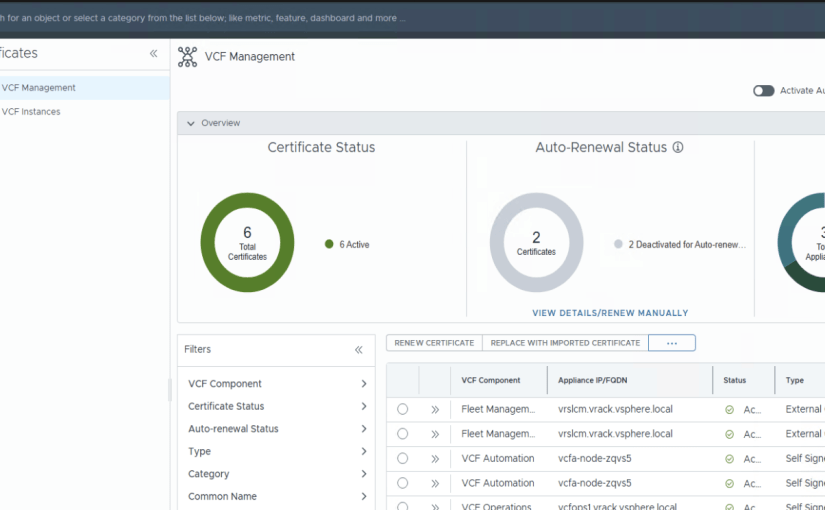
Today, we are going to talk about a massive jump, which is moving from VMware Cloud Foundation (VCF) 5.2 to VCF 9.0. this is not just a version change, it is a foundational re-architecture. Broadcom has pivoted VCF from a collection of loosely coupled products (vSphere, vSAN, NSX, Aria) into a unified platform designed to feel like a public cloud on-premises.
Let’s talk about what is actually changing from technical perspective.
1. Unified Management: The “Fleet” Revolution
In VCF 5.2, we were often jumping between tabs—SDDC Manager for lifecycle, vCenter for VMs, and Aria for operations. It was a bit of a mixture of different interfaces.
VCF 9.0 fixes this with a Unified Console.
- The Fleet Concept: You no longer manage “instances” in isolation. You manage a VCF Fleet. This is a single management plane (VCF Operations & VCF Automation) that can control multiple VCF deployments across different locations.
- SDDC Manager Integration: The functions of SDDC Manager are being merged into VCF Operations. This means your licensing, certificate management, and password rotations are now in one place.
2. Compute – Memory tiering
We all know that DRAM is expensive, Advanced Memory Tiering with NVMe in VCF 9.0 is a absolute relief. VCF 9.0 allows you to use high-speed NVMe drives as a secondary tier of memory. By this we can offload “cold” memory pages to high-speed NVMe storage while keeping “hot” data in DRAM, VCF 9.0 can achieve up to 40% better server consolidation.
3. Networking: Use of VPC
VCF 9.0 pushes the Virtual Private Cloud (VPC) construct as the primary way to consume networking.
- Self-Service Networking: In 5.2, creating complex network segments often required a “ticket” to the network admin. In 9.0, users can self-provision isolated VPCs with built-in security, routing, and load balancing via the VCF Automation portal.
- Enhanced Data Path (EDP): Version 9.0 enables the Enhanced Data Path by default, offering up to a 3x performance boost for packet-heavy applications.
4. Storage: Global Deduplication & Unified storage dashboard
- Global Deduplication: VCF 9.0 introduces integrated global deduplication across the cluster, which can reduce storage costs by up to 46% per terabyte compared to older configurations.
- Unified Storage Dashboard: Instead of jumping between vCenter and Aria to see storage health, 9.0 provides a single pane of glass for vSAN, SAN, and NAS performance and capacity forecasting.
5. Licensing: No More Key Confusion
Remember managing 15 different license keys for vSphere, vSAN, and NSX in VCF 5.2? managing multiple keys was messy.
- Single Solution License: VCF 9.0 moves to a License File system. One file covers the entire stack. You load it once into the VCF Operations console, and it handles the rest. It’s cleaner, simpler, and much harder to mess up.
This is it for today discussion, tried to keep it short & crisp, will be discussing in deep in upcoming blogs, with Lab demos.
Thanks !
Prashant Pandey

 NSXworld